Why Do Cats Need Taurine?

Your cat may look perfectly happy eating the same food every day. But hidden inside that food is a nutrient their body depends on for healthy vision, heart function and more.
It’s called taurine.
Unlike humans and many other animals, cats cannot produce enough taurine on their own to meet their needs. They must obtain sufficient amounts through their diet.
This makes taurine more than just another ingredient on a pet food label. It’s an essential part of keeping your cat healthy.
But why do cats need taurine so much, and does giving them extra actually make them healthier?
What Exactly Is Taurine?
Taurine is a sulfur-containing compound often described as an amino acid, although it isn’t used to build proteins in the same way as most amino acids.
It plays several important roles in the body, including supporting normal vision, heart muscle function, reproduction and bile acid production.
Taurine is found naturally in animal tissues, particularly meat, fish and organs.
For cats, however, the important question isn’t simply whether their food contains taurine. It’s whether their overall diet provides enough to meet their nutritional needs.
Why Can’t Cats Make Enough Taurine Themselves?
Many animals can produce taurine from other sulfur-containing amino acids, such as methionine and cysteine.
Cats can make some taurine, but their ability to synthesise it is limited.
They also use taurine to form bile salts, which help the body digest and absorb fats. Unlike many other mammals, cats rely heavily on taurine for this process.
As a result, their dietary requirement for taurine is particularly important.
This is one of the reasons cats are considered obligate carnivores. Their bodies have evolved to depend on nutrients naturally available in animal-based foods.
A cat’s nutritional needs aren’t simply those of a smaller dog. Their metabolism works differently.
What Happens If a Cat Doesn’t Get Enough Taurine?
Taurine deficiency may develop gradually, which means the consequences aren’t always immediately obvious.
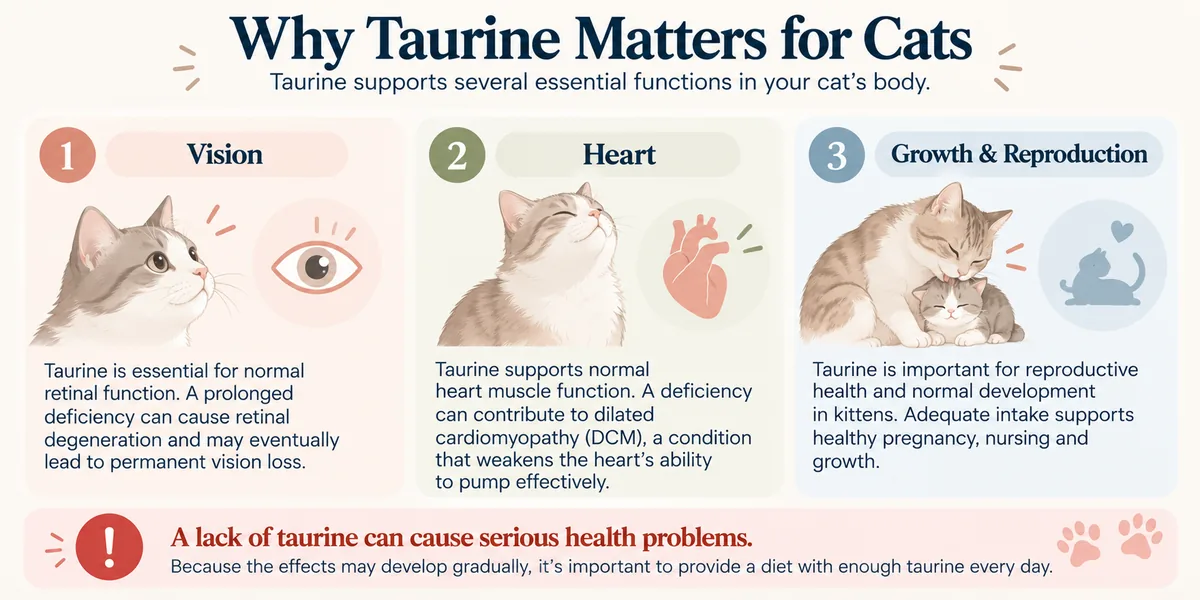
1. Vision Problems
Taurine is essential for maintaining normal retinal function.
A prolonged deficiency can cause feline central retinal degeneration, a condition that damages the retina and may eventually lead to permanent vision loss.
Because these changes can develop before an owner notices obvious symptoms, prevention is especially important.
2. Heart Problems
Taurine also supports normal heart muscle function.
In some cats, a prolonged deficiency can contribute to dilated cardiomyopathy (DCM), a condition in which the heart becomes enlarged and its pumping ability weakens.
Taurine supplementation may improve heart function in cats with taurine-deficiency-associated DCM, particularly when the condition is recognised early. However, not every case of feline heart disease is caused by taurine deficiency.
3. Reproductive and Developmental Problems
Adequate taurine is important during pregnancy and early development.
Deficiency can affect reproductive performance and normal development in kittens.
This makes appropriate nutrition particularly important for pregnant and nursing cats, as well as growing kittens.
Does More Taurine Mean a Healthier Cat?
Not necessarily.
Because taurine is essential, it’s easy to assume that adding more must provide extra benefits.
But there’s an important difference between preventing a deficiency and improving health beyond normal nutritional requirements.
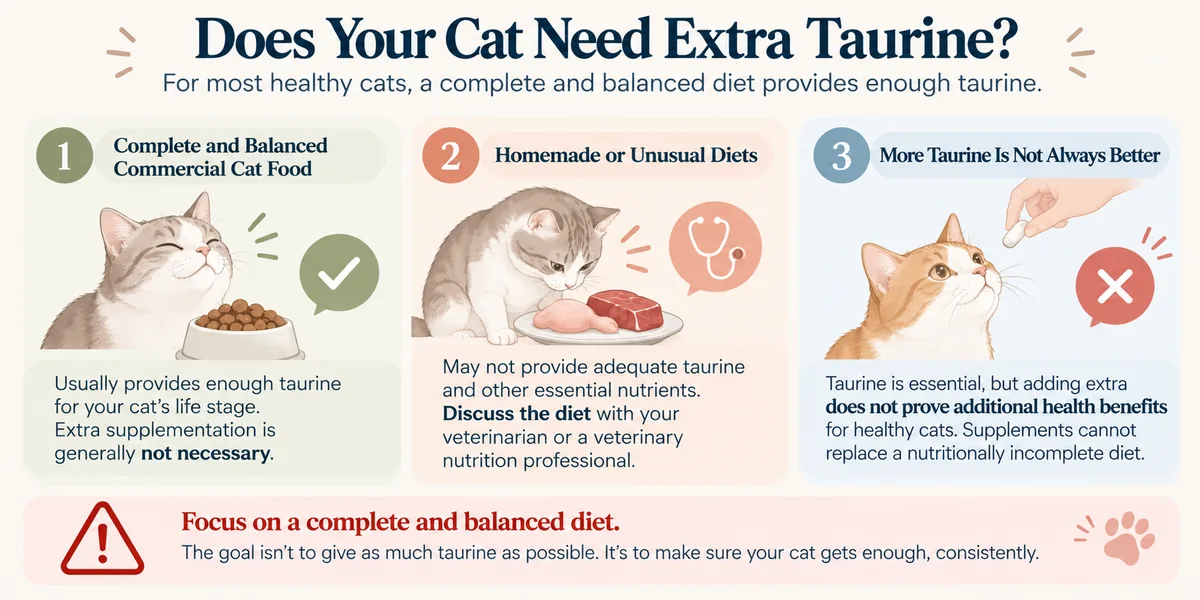
For most healthy cats eating an appropriately formulated complete and balanced commercial diet, additional taurine supplementation is generally unnecessary.
There is no established evidence that routinely adding extra taurine to an already adequate diet improves a healthy cat’s vision or heart health.
A supplement also cannot compensate for a diet that is otherwise nutritionally incomplete.
The goal isn’t to provide as much taurine as possible. It’s to provide enough, consistently.
Do Wet Food and Dry Food Contain Different Amounts of Taurine?
They can.
Taurine requirements in formulated cat foods may differ depending on the type of food and how it is processed.
For example, recognised nutritional standards such as AAFCO specify different minimum taurine concentrations for dry and canned cat foods.
This doesn’t automatically mean wet food is better or that dry food is deficient.
Manufacturers formulate foods to account for nutritional requirements, ingredient composition and processing conditions.
What matters most is whether the finished product is nutritionally adequate for your cat’s life stage.
Instead of comparing taurine numbers in isolation, look for a nutritional adequacy statement indicating that the food is complete and balanced for the intended life stage.
Which Foods Naturally Contain Taurine?
Taurine is naturally present in many animal-based ingredients.
Examples include:
- Meat: Animal muscle tissues provide taurine, although amounts vary.
- Fish: Many fish contain taurine, but their nutritional composition differs by species.
- Organ meats: Certain organs can provide substantial amounts of taurine.
- Commercial complete cat food: Properly formulated products contain taurine at levels designed to meet feline nutritional needs.
However, simply feeding meat or fish doesn’t guarantee a nutritionally balanced diet.
Cooking, processing, ingredient selection and the proportions of different foods can all influence the nutritional content of a homemade diet.
A diet made entirely from meat may still be deficient in other essential nutrients, even when it contains taurine.
For this reason, homemade diets should be formulated with guidance from a qualified veterinary nutrition professional.
How Can You Tell If Your Cat Is Getting Enough Taurine?
You usually can’t determine taurine adequacy just by watching your cat.
A cat may appear healthy while a nutritional deficiency is developing.
A practical starting point is to check the food you provide.
- Nutritional adequacy statement: Indicates whether the food is formulated or tested to meet recognised nutritional requirements
- Life stage: Kittens, adults and reproducing cats have different nutritional needs
- Complete vs. complementary food: Complementary foods aren’t intended to provide all essential nutrients on their own
- Homemade or unusual diets: May require professional nutritional assessment
- Supplements: Should be considered in the context of the complete diet, not individual ingredients alone
If your cat eats a homemade diet, a restricted diet or food not intended as a complete daily diet, discuss its nutritional adequacy with your veterinarian.
If taurine deficiency is suspected, a veterinarian may recommend appropriate testing and dietary assessment.
Final Thoughts
Taurine is a small nutrient with an unusually important role in feline health.
It supports normal vision, heart function and other essential processes, yet cats cannot produce enough of it to meet their needs without dietary intake.
But that doesn’t mean every cat needs a taurine supplement.
For most healthy cats, the best approach is to provide a complete and balanced diet appropriate for their life stage.
PAW PROMISE — A promise to every paw. Every day.
This article is for educational purposes and does not replace veterinary advice.